
Aerial perspective
March 4, 2026

 På Svenska
Aerial perspective is the term used to describe the phenomenon whereby a landscape appears lighter, bluer, and less distinct at a great distance. The effect occurs when the air is filled with moisture and small particles that partially obscure the subject—the greater the distance, the stronger the effect.

To some extent, aerial perspective is always present, but it is most visible in hazy weather. In clear sunlight, on a beautiful summer day, less of the landscape is obscured by haze and airborne particles.
Historically, aerial perspective has appeared in painting at least since the Renaissance (and, if one is generous, one might say already in Antiquity). Artists such as Jan van Eyck and Leonardo da Vinci (15th century) made use of it.
For the watercolor artist painting landscapes, aerial perspective means working with reduced contrast and reduced color saturation in the distance—using more diluted and cooler tones far away, and gradually introducing richer color, stronger contrast, and warmer hues as the landscape approaches the viewer. The ideal is to achieve a gradual transition from cool and light to warm and more saturated.
Technically, this means beginning with the most distant parts of the landscape. One uses light values and preferably cool, slightly bluish color. Contrast and sharpness are reduced. If the subject allows it, working wet-in-wet helps create soft transitions that enhance the sense of distance.
Once the first layer has dried, the middle ground—being somewhat closer—is painted with slightly stronger and less bluish color. This process continues until the foreground is completed, using warmer and darker colors.
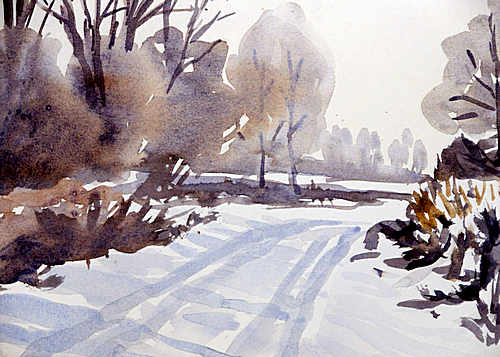
Each layer should be allowed to dry before the next, slightly darker part of the landscape is painted.
Aerial perspective can be used in all types of painting that depict significant distance. It enhances the sense of depth in the image.