
Terre Verte (Green Earth) PG23
January 5, 2026
 På Svenska
This text was revised with new illustrations on January 5, 2026.
Green earth is a natural mineral pigment traditionally obtained from the minerals celadonite and glauconite. It was already in use in ancient Rome, where it was a common and widely used color. Green earth has been identified in frescoes in Pompeii, Herculaneum, Stabiae, and Rome. The pigment was chemically stable in lime, and the fresco technique particularly favors stable earth pigments.

Kritzolina, CC0, via Wikimedia Commons

Rob Lavinsky, iRocks.com – CC-BY-SA-3.0, CC BY-SA 3.0 <https://creativecommons.org/licenses/by-sa/3.0>, via Wikimedia Commons
During the Middle Ages and the Renaissance, green earth continued to be popular. In the early Renaissance, it was almost a standard pigment in figure painting. Over time, however, it lost prominence—especially during the Baroque period (17th century), when it was replaced by various color mixtures and later by synthetic pigments.
The traditional way of using green earth was not to paint visible green. Instead, it was often used in underpainting to neutralize red tones and create cool shadows. It appears particularly in flesh tones, where it contributes to luminosity and balance.
Green earth thus functioned as a tonal tool—a way of controlling color rather than displaying color. It was used to subdue chromatic intensity, build shadows without black, and create a cool counterbalance to red, especially in faces.
As older, traditional painting methods—requiring planning, underpainting, and tonal control—were gradually replaced by a more colorful and coloristic approach, green earth became redundant. It was not replaced by other colors but simply abandoned. When painting’s approach to color shifted from tonal structure to coloristic effect, green earth’s strength became its weakness.

ArchaiOptix, CC BY-SA 4.0 <https://creativecommons.org/licenses/by-sa/4.0>, via Wikimedia Commons
Today, imitations—often more colorful than the genuine pigment—are quite common, although authentic green earth is still available in manufacturers’ ranges. The hue of genuine green earth varies greatly depending on where the mineral was quarried. It can be yellowish pale, muted cool green, or even bluish. Imitations show similar variations in hue.
In other respects, green earth—at least the genuine pigment—has similar properties regardless of origin. It granulates and adheres only lightly to the surface. The color is transparent to semi-transparent and remains immobile in water. It is always very pale.
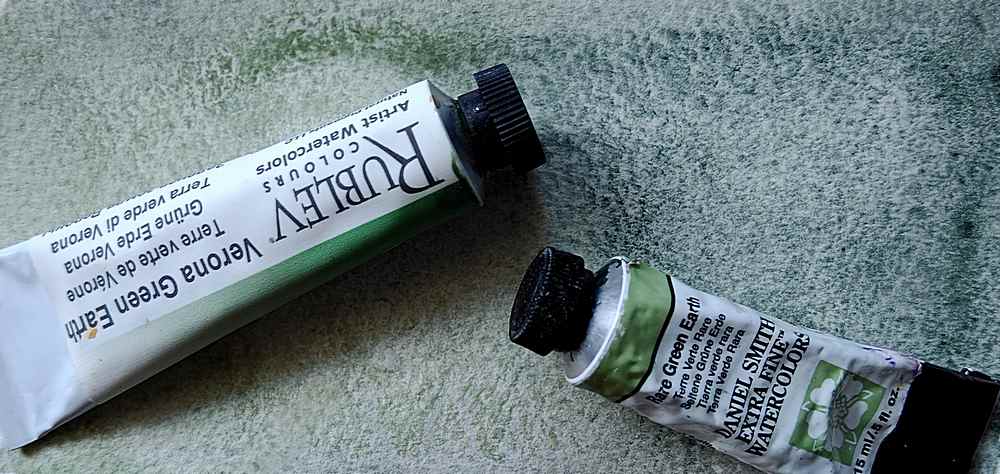
In terms of naming, the pigment is most commonly called Terre verte or Green Earth. Sometimes additional descriptors such as Yellow Shade or Bluish are added. Some manufacturers also use well-known locations in the name, such as Bohemian Green Earth or Verona Green Earth.
In addition to genuine and imitation versions, green earth is often sold mixed with other modern pigments. Common additives include phthalo green (PG7) or chromium oxide green (PG17), both of which make the color distinctly greener.
Because imitations and mixed pigments are so common, it is wise to check the Color Index name before purchasing. Genuine green earth has the color index designation PG23. It is also a good idea to compare several manufacturers, as green earth can look very different depending on where the mineral was sourced. The pigment is usually inexpensive and placed in the manufacturer’s lowest or second-lowest price series.
Information
Color Index Name: PG23
Lightfastness: Excellent
Transparency: Transparent to semi-transparent
Staining: No, not at all
Granulation: Yes
Hue: Pale, yellow-green to blue-green, sometimes more gray



Lovely color
Interesting…I had never heard of this color. I’m wondering if it’s similar to Daniel Smith’s Cascade Green?
I have never used Cascade Green, I stay away from mixed colors, but what I can understand from the pigments included is it is very different from Rare Green Earth. The hue may be similar but other characteristics should be completely different. Rare Green Earth is very weak and unclear. Cascade Green is strong and intense.
It’s nothing like Cascade green. Cascade green is made of Raw Sienna and pthalo blue. It is a green that is bright and deep somewhat toward pthalo blue green shade. As it dries it separates into pthalo blue, yellowish and the green. It’s interesting for deep forests. I’m still learning the best way to use it.