

Enhancing Granulation

 På Svenska
When using granulating colors in a painting and wanting to emphasize the patterns these pigments create, you can’t paint in the usual way. You need to create an environment that these colors enjoy “bathing” in. You also need to understand that once the surface is painted, it becomes very delicate and should be left untouched.
I’ve come to understand that some watercolor painters dislike granulation and try to hide it as much as possible. This text is not intended for them. Here, I will describe how to enhance granulating colors to create beautiful, textured patterns.
Sedimentary and Flocculating Colors
There are two main types of granulating paints: sedimentary and flocculating. What they have in common is that both leave visible textures and patterns on the paper surface. To achieve these patterns, you can use similar yet slightly different techniques.
Sedimentary colors create patterns because their pigment particles are large and heavy. They sink quickly into the wet paint, settling into every little dip and irregularity on the paper surface, accumulating in the depressions. Once the paint has dried, the result is a grainy texture that, apart from the graininess, is evenly distributed across the paper.
Flocculating colors, on the other hand, form patterns because the pigment particles tend to clump together (they “flocculate”) into larger clusters. These paints can produce the most surprising and interesting textures and are applied differently from sedimentary colors to bring out such effects.
The Importance of Paper
The choice of paper greatly affects how granulating colors behave. For sedimentary paints, the rule is simple: the rougher the paper, the stronger the granulation effect.
A smooth watercolor paper simply doesn’t have enough or large enough “valleys” in its surface to collect pigment particles. The result is therefore a less pronounced texture. A rough paper, on the other hand, can effectively produce large pigment deposits, since its uneven surface provides generous “parking spaces” for pigment clusters.


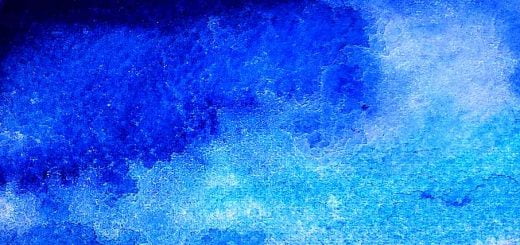
Painted with a mix of French Ultramarine, Manganese Blue, and Mummy Bauxite.
The sizing of the paper also affects the degree of granulation. Heavily sized paper stays wet longer, since the sizing prevents the paint from being absorbed too quickly. As the wet paint is gradually absorbed, the pigment particles have plenty of time to settle into the paper’s texture. Soft-sized paper, however, absorbs paint quickly, leaving less time for distinct granulation patterns to form.
If maximum granulation is your goal, use the roughest watercolor paper you can find. To further enhance the effect, choose a hard-sized paper with coarse texture. (This article can help you find papers with different degrees of sizing.)
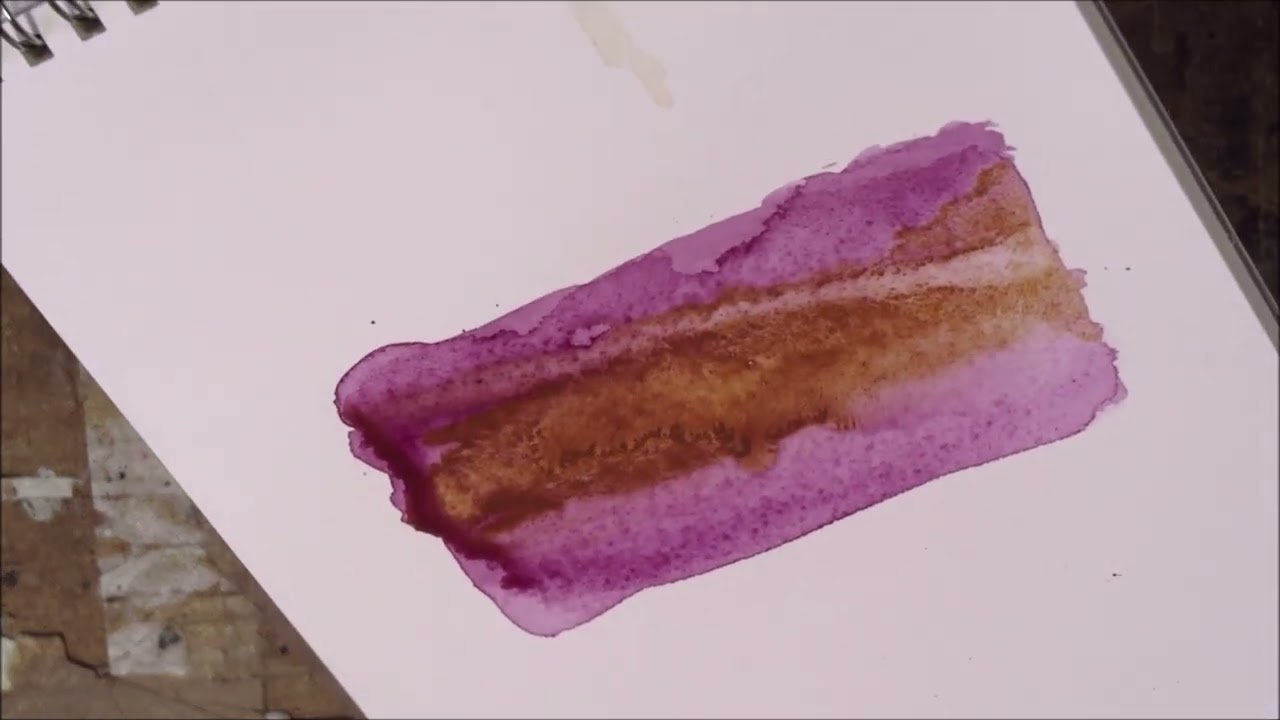

The video above shows how to create interesting textures on hot-pressed paper using flocculating colors.
Painted with Manganese Violet and Transparent Yellow Oxide on Arches 300 gsm HP.
Flocculating colors behave similarly to sedimentary ones when it comes to paper choice—as long as you paint in the “usual” way. But if you create patterns by moving the pigments afterward—by adding water or more paint, or by guiding the paint flow to form specific effects—a hot-pressed paper might be preferable. Flocculating colors don’t need the unevenness of rough paper to produce patterns. The smooth, hard surface of hot-pressed paper acts as a barrier to the water, allowing the pigments to float and interact on the surface for a longer time, creating fascinating textures.


Creating Beautiful Patterns
Regardless of which type of paint you use or what kind of texture you want to achieve, the key is generous amounts of paint and water. You can’t be cautious and sparing and still get strong granulation. Avoid rubbing or fussing with the paint, especially once it has started to settle. The best results come from a single, freely applied, generous wash.
To create a strongly textured pattern with sedimentary paints (the most common type of granulating color), follow these steps:
- Choose paints that granulate as much as possible. (Find them here.)
- Use paper with the roughest texture available—preferably hard-sized. Both of these properties enhance granulation. (Information on sizing grades can be found here.)
- Paint only one layer, with plenty of pigment and water. The more paint, the stronger the effect.


French Ultramarine on Arches Rough.
If you are using flocculating colors and want to enhance their special properties, do the following:
- Choose paints that flocculate strongly. (Find them here.)
- On rough paper, you can get threadlike or spontaneous patterns. On smooth paper, larger patches or clusters of pigment form more easily.
- Move (“guide”) the paint by tilting the paper in different directions. Add more water and pigment as needed. Be patient—it takes longer to form patterns than you might think.
Once a pleasing pattern has appeared, it’s crucial not to touch the surface again. This is very important. A fully painted, granulated area is extremely delicate and should never be disturbed. Granulating pigments are generally easy to lift; they don’t adhere strongly to the paper. This means it’s very easy to ruin a beautiful granulation by painting over it.
Examples of Sedimentary Colors
- French Ultramarine PB29
- Viridian PG18
- Various Cobalt colors (blue, green, and violet)
- Peach black (Vine black) and Ivory Black PBk8 / PBk9
- Ultramarine Violet PV15
- Several Earth colors
Examples of Flocculating Colors
- Iron Oxide Black (Mars Black, Lunar Black) PBk11
- Magnesium Ferrite PBr11
- All Transparent Brown, Red, and Yellow Oxides (Daniel Smith)
- Manganese Violet PV16
- Various genuine mineral pigments (e.g., Hematite, Sodalite, Blue Apatite)


Hey there!
I’ve been trying to replicate the DS Lunar Black color with PBk11 pigments. For some reason it granulates but doesn’t flocculate. I tried mixing a LOT of pigments with the watercolor binder but so far I can’t make it work. Any idea what might work? Perhaps adding granulating medium into the mixture?
Thanks a lot!
That’s very strange. I have no idea why your paint doesn’t want to flocculate. I’ve never used granulating medium, so I don’t know what effect it might have.