Why are earth colors so different?
April 19, 2026
 På Svenska
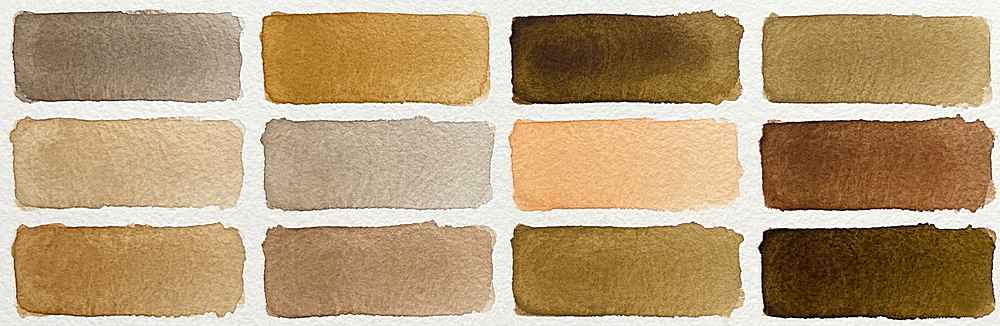
The image above, the header image for this text, shows various swatches of raw umber. Earth colors often differ radically between manufacturers. Colors with the same name can look completely different depending on who made them. Other colors, such as French ultramarine or phthalo green, tend to vary only slightly between manufacturers. So-called earth colors display a much wider range of hues.
Natural earth colors are not very common today. Since the mid-20th century, synthetic pigments have increasingly replaced traditional natural earth pigments. The original pigments could vary greatly depending on their origin.
Let’s take umber as an example. Historically important sources of umber included:
- Umbria, Italy: often quite dark and rich in manganese.
- Castile, Spain: could vary greatly in tone, from warm to fairly cool.
- The Ardennes (Belgium, Luxembourg, and France): often with a gray or slightly greenish undertone.
- Bavaria and other parts of Germany: often more yellow-brown or slightly red-brown, and somewhat cleaner in tone.
So the color umber could vary significantly depending on the pigment’s origin. The same variation was found in other natural earth colors such as ochre, sienna, and green earth.
As paint manufacturers gradually shifted to synthetic pigments, a key question arose: which earth color should be imitated? A synthetic yellow ochre is likely based on the pigment PY42, which is a synthetic yellow iron oxide. But which natural ochre should it resemble? Should it be the muted, soft ochre from Italy, or the warm yellow-orange from Roussillon in France? Perhaps the pale ochre from Cornwall is a better choice than the deeper, browner variety from Cyprus. There are so many natural colors with the same name but from different places that the possibilities are numerous.
Synthetic earth pigments can also be manipulated through crystal structure, particle size, and additives. This means that the same pigment can exhibit very different properties and color tones depending on how it is produced. The synthetic iron oxide pigment PR101 is a good example of a pigment with great variation. It can be the coloring agent in paints ranging from opaque orange-browns to transparent violet-blacks.
This is a key reason why modern synthetic earth colors differ so much, even when they share the same name and often the same pigment. There are many historical variants of the classical originals. A modern burnt sienna can vary considerably depending on the manufacturer. It may be transparent or more opaque; its hue may range from grayish red-brown to vivid orange-brown; and it may granulate or produce completely smooth washes.
Given such variation in modern earth colors, it may be more important to choose a color based on its hue and properties rather than its name. A burnt sienna from one manufacturer may resemble a burnt umber from another. A yellow ochre may be very similar to a raw sienna from a different brand. Often, the same pigment is used in these different paints.
Next time you are buying, for example, burnt sienna, it may be worth considering more options than those actually labeled “burnt sienna.” There are many transparent or semi-transparent orange-brown colors to choose from. Perhaps a flocculating Transparent Red Oxide or a granulating Mummy Bauxite might appeal. Various paints labeled Mars red are also an option, as well as different red ochres or the classic Pozzuoli red. There are many colors that can serve the same purpose as burnt sienna but have different names. This applies to all so-called earth colors.
Perhaps we should abandon the traditional names for synthetic earth colors and instead call them dark brown, yellow-brown, or orange-brown. These names could then be refined with modifiers such as cool, warm, or muted. After all, none of them are truly ochres or umbers—they have nothing to do with earth. In that case, one would immediately know that a color named yellow ochre is a genuine earth pigment; otherwise, it would be called something like bright yellow-brown.


