Misty Farm in Skåne
December 28, 2025
 På Svenska
This painting is fairly simple to execute and works well as an exercise for those who are relatively new to watercolor painting. Large smooth areas, no perspective, and simple color mixing make it well suited as a practice painting. Choose a sheet of watercolor paper approximately A4 in size (Letter size); this is a comfortable format for this painting. With a larger sheet, the smooth areas become difficult to control, and with a smaller one, the buildings become unnecessarily fiddly.
The colors used in this exercise are cobalt blue, burnt sienna, raw sienna, and a cool red, such as quinacridone rose or alizarin. The blue may be replaced with French ultramarine if you do not have cobalt. The two earth colors can be substituted with any orange-brown and yellow-brown colors of your choice.

Step 1
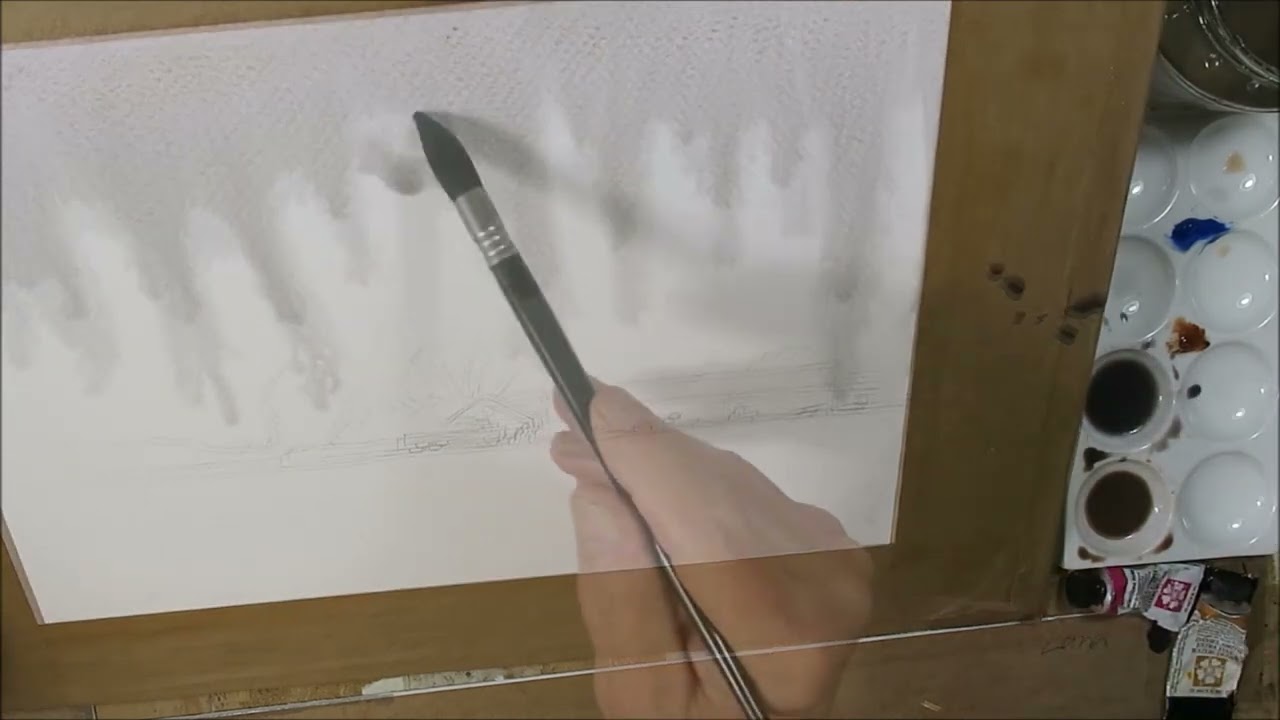
Mix your blue and brown to create a gray color. Make a generous amount of paint—at least two tablespoons. The mixture should be quite light; it is meant to create a gray mist in the painting, not a strong tone.
Begin by wetting the entire sheet with water. Use enough water that it flows freely on the surface of the paper. When you tilt the paper, you should be able to see the water moving across the surface.
Using a large brush, dab or brush the gray mixture onto the wet paper. Then tilt the paper in different directions so the color spreads evenly across the entire surface. The blue pigment, being granulating, will create a slightly grainy texture, which is visually pleasing. Once you have achieved an even wash, lay the paper flat to dry. Then go and have a cup of coffee or something similar—it takes a long time for such a wet sheet to dry completely.
Step 2

When the coffee has been drunk and the painting is dry, it is time to paint a few treetops behind the houses. If you still have some of the gray mixture left, use it, possibly with a little extra brown added. Otherwise, mix a new batch of blue and brown, approximately the same strength as the initial gray.
Also paint the narrow greenish strip of grass in front of the houses. Creating a green color from raw sienna and cobalt blue (or French ultramarine) is not easy. If you don’t achieve a satisfying green, make it more yellowish—that works just as well.
Step 3

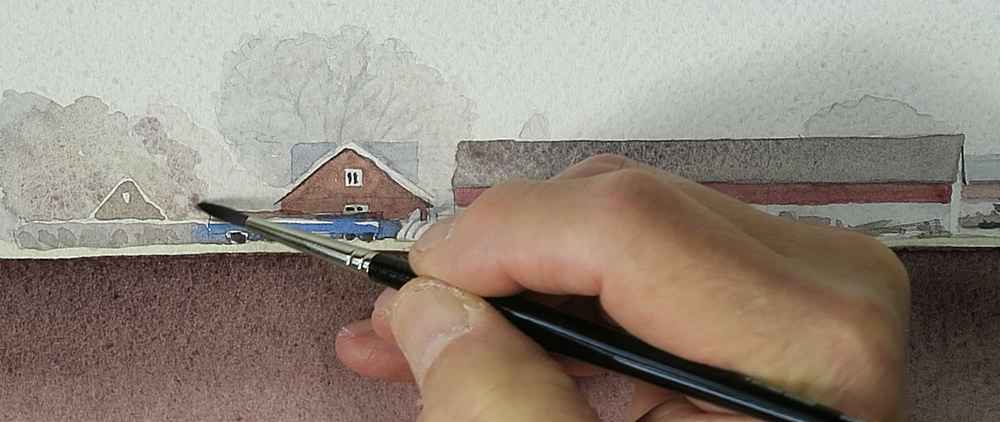
When the background trees are dry, it is time to paint the houses. Remember to preserve details such as windows, doors, and vergeboards. The Falu red details are mixed from red and brown. Black or gray can be mixed from blue and brown.
You can also paint a few trunks and branches on top of the large tree.
Step 4

I painted the distant trees before the field at the bottom of the image, but it would have been wiser to do them before the houses. Hindsight is always clearer. If you wish, you can move this step to the beginning of step 2.
The large brown field in the foreground is painted using varied mixtures of brown, red, and blue. Do not use a single mixture for the entire field—it will look dull. Add paint and water generously so that you can coax the color into a smooth surface by tilting the paper in different directions.
Try to make the field darker toward the top to create a sense of depth in the painting. Once the field is finished and dry, you can add details you may have missed in earlier steps. That is, at least, what I did.


I did this exercise on a 23×31 300g rough Arches, with cobalt blue (W&N), Italian burnt sienna (DS), Monte Amiata natural sienna (DS) and permanent rose (W&N). Brushes were a 5 Kolinex for the fiddly bits and a cheap 1″ pig hair flat mottler, to try to get a contrast in the calligraphy between the houses and the field. This worked out pretty well and was fun to do. I could also get both a good neutral and a decent green, although I think I should have diluted the green more. Biggest problem was the wobbly paper since I use a block, this caused the cobalt blue and burnt sienna to separate and form vertical stripes in the valleys of the paper. I’m celebrating this by calling it a smokey day, since people on unpainted farms in the background are burning heaps of leaves. If I had done the painting in portrait format, I think I could have gotten away with it by calling them clouds instead.