Lemon Ocher (PY43)
April 29, 2026
 På Svenska
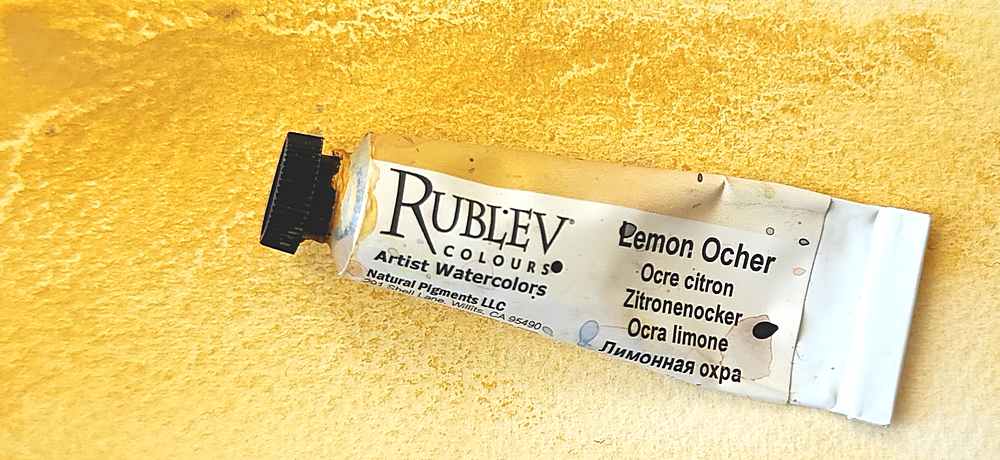
One of my favorite yellow paints is Lemon Ocher from Rublev, which is the name given to these artist paints by the pigment manufacturer Natural Pigments. Natural Pigments produces oil and watercolor paints in a traditional way, completely without modern additives.
Natural Pigments’ watercolors consist of pigment, gum arabic, and a sugar solution—nothing more. No additives such as thickeners, dextrin, or synthetic substances, and no fillers or brighteners either. Just traditionally made, handcrafted watercolor paint produced on a small scale, resulting in very high quality. The downside is that the paints can sometimes be out of stock while waiting for the next production batch.
Despite the small-scale production, the natural pigments, and the traditional manufacturing method, the price is roughly the same as for other professional-quality paints. I am not sponsored by Natural Pigments—I simply want to highlight one of my favorite watercolor paints.
www.naturalpigments.eu/ – www.naturalpigments.com/ – www.naturalpigments.ca/
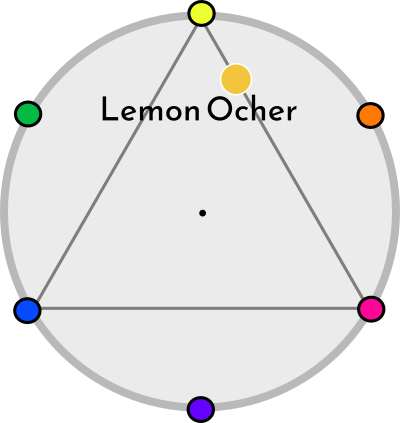
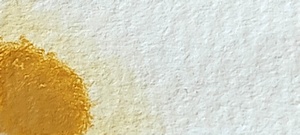
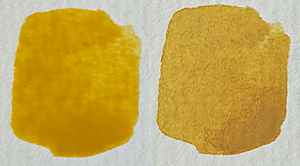
Rublev has around a dozen watercolor paints that they call ochres, or that go by other names but are essentially ochres. Among these, Lemon Ocher is the cleanest and coolest in tone. That is precisely the quality I appreciate most. Its clean, cool hue allows it to function as a yellow in a painting, not just as an earthy yellow-brown.
This goethite-rich earth, which forms the basis of the pigment in Lemon Ocher, comes from northern Italy. Goethite is the name of the iron hydroxide that forms when iron reacts with water and oxygen. The mineral is named after Johann Wolfgang von Goethe, who had many talents (he also worked in mineralogy).
The paint is very durable, lightly staining, and relatively immobile on wet watercolor paper. It has a slight granulation, and the pigment shows a clear tendency to flocculate. According to the manufacturer, Lemon Ocher is transparent, but I would rather describe it as semi-opaque.
Among yellow earth pigments, Lemon Ocher is one of my absolute favorites. Few can match this beautiful and unpretentious, cool and clean yellow. Despite its obvious drawbacks—somewhat resistant in water and fairly covering—it is one of my standard colors. It is so clean and clear that it can replace a “regular” yellow.
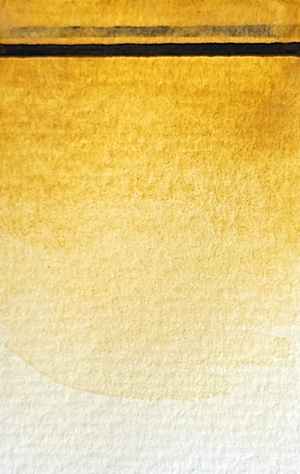
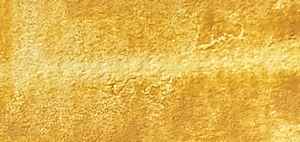
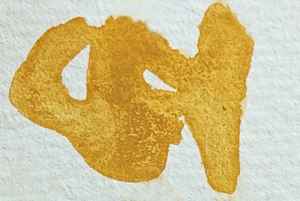
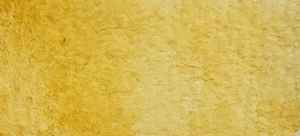
Color Index Name: PY43
Lightfastness: Excellent
Transparency: Semi-opaque
Staining: Slightly staining
Granulation: Yes, with flocculation
Hue: Fairly cool, slightly muted yellow