Burnt and raw
August 5, 2025

 På Svenska
Some earth colors occur in both burnt and raw forms. This applies mainly to siennas and umbers, which often have these designations added to their names. Occasionally, other earth colors may also have such additions—for example, burnt ochre—but these are less common.
In English, the unburnt version is referred to as “raw,” but in Swedish, the term is obränd (unburnt). I’ve noticed that many Swedes nowadays refer to, for instance, obränd sienna as rå sienna (raw sienna), but that is not the correct term in Swedish. The correct name is obränd sienna. English language usage and words have a tendency to sneak into Swedish unnoticed.
Earth Pigments
Earth pigments are derived from naturally colored soils. The soil is dug up and dried, then sieved to remove stones, roots, and other unwanted debris. It is then washed in water—often multiple times—and what remains is ground into a fine powder, becoming an earth pigment.
Iron hydroxides form when iron comes into contact with water and oxygen. This is a common process that happens everywhere in nature—in soil, in rocks, and even in ditches or puddles. The result is typically a yellowish substance visible in soil layers, for example. These iron hydroxides form the basis of many earth colors such as sienna, umber, and ochre.
Burnt Pigments
When a yellow earth pigment—such as sienna, which consists mainly of iron hydroxides and manganese hydroxides—is heated, these substances convert into iron and manganese oxides, which are darker and redder. The result is what we call burnt sienna.
There is evidence that as far back as ancient Egypt, and later in Greece and Rome, some earth pigments were fired to achieve this color transformation. Even though the technique of burning earth pigments is at least 3,000 years old, such pigments are hard to find in today’s commercial ranges. Almost everything available now is made using synthetic pigments, produced through a chemical process with precise control over oxidation levels and crystal structure.
Although burning is no longer necessary today, the names persist as historical relics. A modern burnt or raw umber is not a pigment that was naturally mined and then treated to become watercolor paint. It is a color produced under very controlled conditions through a chemical process.
Manufacturers
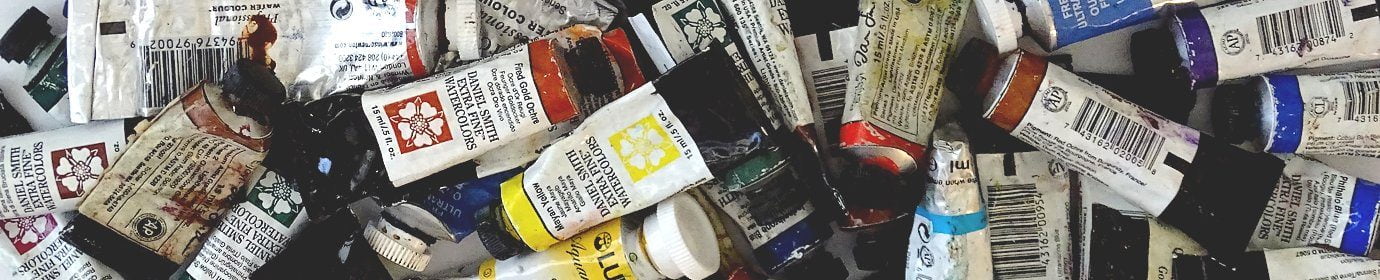
Natural earth pigments still exist today, but they are difficult to find. Among the larger manufacturers, Daniel Smith, Rosa Gallery, A. Gallo, and Roman Szmal are worth mentioning, although they don’t offer many, and they can be hard to find. Kremer Pigmente and Wallace Seymour have a broader selection of natural earth and mineral pigments. One standout manufacturer is Natural Pigments, which offers a large range of natural earth colors and is easy to order from.
Finding Genuine Earth Colors
The pigment index name is not a reliable indicator that a pigment is genuine. PBr7 is supposed to denote natural earth color, and PY43 a natural yellow iron oxide. But manufacturers use these designations very loosely—nowadays they are applied to both natural and synthetically produced pigments.
Check the name of the paint: if it includes the word natural or genuine, that’s a possible indication the pigment might be authentic. A paint named Genuine Italian Ochre or Natural Sienna has a good chance of being what you’re looking for. Before buying the paint, visit the manufacturer’s website—many provide detailed descriptions of their products. A description such as “made from soil from Tuscany” or “mineral pigment from Cyprus” suggests that the pigment is authentic.