
Phthalo blue (red shade)
December 8, 2025

 På Svenska
This is an updated version of the text and images first written on August 5, 2020.
It was discovered by accident in the 1920s and produced as a pigment in 1935, under the name Monastral Blue—a name that is still in use today. When the pigment was introduced, it was regarded by many as the most important advance among blue colors since French Ultramarine (1826).
The pigment is extremely stable and highly resistant to light, solvents, and weathering, which makes it useful in everything from artists’ paints, printing inks, plastics, rubber, and textile printing to construction materials (cement and concrete), house paint, and even as a colorant in toothpaste. It is one of the most widely used blue pigments worldwide.
Its Color Index name is PB15:1, although some manufacturers use PB15:6. The color is often sold under other names, which can be confusing. The most common alternative names are Berlin Blue (which should technically refer to Prussian Blue), Helio Blue, and Monastral Blue. Some manufacturers simply call the color Blue, while others name it after themselves: Winsor Blue, Blockx Blue, Bleu Sennelier.
Phthalo Blue, red shade, is the perfect primary blue—no other blue is so precisely positioned on the color wheel. This, in my opinion, makes it an essential color in the paint box, at least if you prefer to mix your own colors.
The color is extremely intense, which makes some watercolor painters find it difficult to use. In that case, one simply has to learn to use it with restraint. It is also very transparent and highly lightfast. It does not granulate at all, but leaves a distinct “bite” when applied generously.
It also has excellent mixing properties, especially toward the green side of the spectrum, but it also works well when mixed with red to create violet hues. Its complementary color is orange-red. It can be difficult to find a good color for neutral mixtures, as most browns tend to become slightly greenish when mixed with Phthalo Blue.


Phthalo Blue moves readily on wet paper and has excellent properties for wet-on-wet painting. The color is also highly staining, which is evident in how easily light-colored brush hairs become tinted and how plastic palettes turn bluish—the staining cannot be removed. This also means that once the paint has dried, it is very difficult to wash it out of watercolor paper.
The color loses much of its value and tone as it dries; the intense blue seen in the wet state becomes grayer and lighter once dry. This is, in my view, the most significant drawback of the color. The beautiful clear blue loses its purity in the dried state.
In summary, Phthalo Blue (red shade) is the most obvious choice for a primary blue. No other blue comes as close to being a perfect primary color. However, the color does have some disadvantages: it dries flat and somewhat dull, it loses a considerable amount of its color brilliance when dry, and it stains heavily—though in certain contexts this can also be an advantage.


Information
Color index name: PB15: 1 | PB15: 6
Lightfastness: Very Good
Transparency: Yes, very
Staining: A lot
Granulation: No.

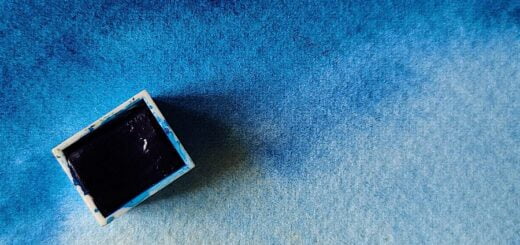


It’s a beautiful blue this one. Just a little goes a long way. If I’m in the right, when I mix it with a little bit of black, I get Indigo
This is how most manufacturers mix their indigo (real indigo is no longer available as a watercolor paint): Phthalo blue (RS) + Lamp Black + a little red.