Lanaquarelle
July 11, 2023
 På Svenska
Lana is an old French paper mill, it has been around since the 17th century, specifically 1590. The name of their watercolor paper is Lanaquarelle. The paper used to be handmade but nowadays is mould made.
The paper is available in thicknesses of 190, 300 and 640 gr² (90, 140 and 300 lb) but the thinnest seems to be hard to find. The color is white, not completely white but almost, it is made of 100% cotton.
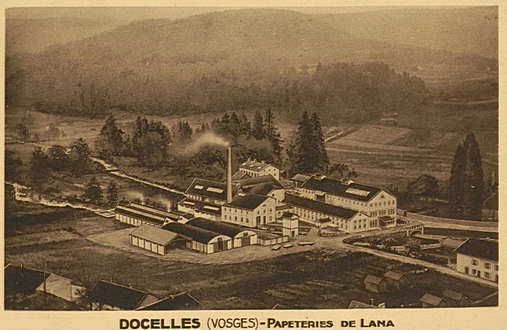
Bibliothèque municipale d’Épinal, CC0, via Wikimedia Commons
Num risation de la carte postale 000004294 de la bmi Epinal-Golbey

Ji-Elle, CC BY-SA 3.0 <https://creativecommons.org/licenses/by-sa/3.0>, via Wikimedia Commons
It is available as blocks in different sizes and thicknesses and in rolls (300gr², 140 lb) and as sheets in the size 56X76 cm (22″X30″) in various thicknesses and 101X152 cm (40″X60″) only 640 gr² (300 lb).
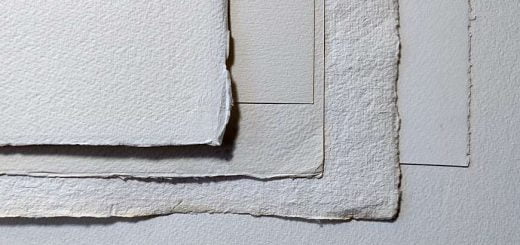
The paper in sheets has deckle edge all around, two natural and two torn, which is customary. The rough paper is considerably smoother than this type of surface usually is. Lanaquarelle’s rough paper has a surface that is more similar to the cold-pressed of other papers.
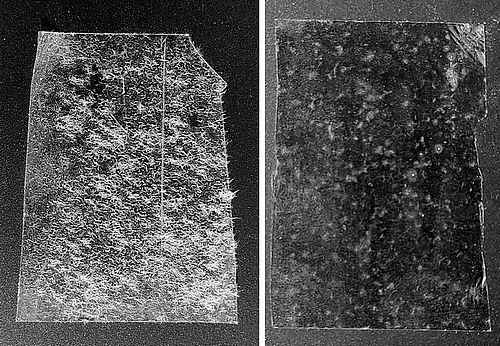
Lanaquarelle is sparingly sized with gelatin, both in the paper pulp and on the surface. The fact that it is not heavily sized makes it soft and absorbent.
That the paper is only slightly sized becomes obvious at the first brush stroke. The paint is absorbed quite quickly by the paper, and it also dries quite quickly. Furthermore, paper is sensitive to masking and rubbing, the paper surface takes a beating from such treatment.
The fact that it is not heavily sized is also noticeable when using flocculating and granulating colors, they are quickly absorbed by the paper and therefore do not have time to form the patterns that distinguish them.
It is the same with colors that form a hard edge, this does not have time to be created before the color has been absorbed, colors that leave a hard edge only get an insignificant line around a fluidly painted surface.
However, the paper is very nice to paint on, it may not be suitable for those who are looking for effects and want the characteristics of the colors to be emphasized. It soaks up fluidly painted paint in a controlled and predictable manner. Wet on wet technique works amazingly well, although you have to be quite fast. There are never any oddities or unpleasant surprises.
A very well-behaved paper that will surely suit many watercolor artists, but not those who are daredevils and like challenges.
But watch out for masking and rubbing, this can damage the paper. Layer on layer – glazing, works convincingly. Layer on layer technique fits Lanaquarelle very well, just be aware that the paper can be damaged if you rub too much.
For me, who often uses lots of water and paint, this paper works great. Fluidly painted dark surfaces become smooth and beautiful effortlessly. But I miss the colors’ own expression on this paper. The result is a bit boring, and without personality.


Name: Lanaquarelle
Manufacturer: Lana
Manufacturing method: Mould made
Material: 100% Cotton
Sizing: Gelatine surface sized, internally sized
Surface: Cold pressed, Hot pressed and Rough
Thickness:190g/m² (90lb), 300 gr/m² (140lb), 638g/m² (300lb)
Color: Natural white
Manufacturer website:
http://www.lanapapier.fr/en/
(A website that is more beautiful than functional,
an all too common phenomenon these days.)




Hi Erik
I just read your post on Baohong paper, and I agree with you, this is a really good quality paper. I live in Århus, Denmark, and fortunately I can buy the paper locally at this reseller:
https://aartdevos.dk
They have a webshoppen, and perhaps you might be able to get the paper here?
This is their mail address:
info@aartdevos.dk
Good luck, and thank you for sharing knowledge and inspiration.
Best Regards
Marianne Haugaard Antonsen
info@aartdevos.dk
Thanks for the tip, Marianne. I’ll check out the shop.