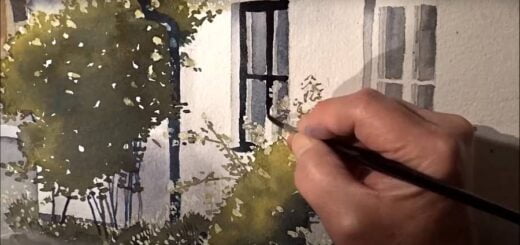

Shadows in watercolor
July 25, 2025

 På Svenska
This painting is based on a photo from the farm I Moricci in Tuscany, where I usually run watercolor courses. It is intended to demonstrate one way of painting shadows in a watercolor painting.

The painting is done with the following colors:
- French Ultramarine – this color is essential in the painting. You could possibly replace it with cobalt blue, but the result will be a bit pale.
- Quinacridone Burnt Orange – an unusual color, but very similar to a burnt sienna, which you probably have.
- Nickel Azo Yellow – any slightly warm yellow will work just fine.
- Viridian – a pleasant granulating green, but any green will do.
Step 1

Mix French Ultramarine with the brown color. Together they should form a gray mix. Since French Ultramarine is granulating, the two colors will separate, especially if you paint wet and loose. Don’t fight this—embrace it as a strength of the painting.
Identify all areas of the picture that are in shadow, except for the urn and the lantern, and paint them with your gray mixture. As you can see, I chose to make the color a bit bluish—I like blue shadows. If you make the mix more neutral, that will work too.
The narrow sunbeams on the ground behind the urn are important, so be careful not to paint over them. Also be mindful of the grass to the left of the urn—this area should be preserved. So, paint a “jagged” grass edge when you do the shadow behind it
Step 2
Let the shadows from step one dry completely before you continue.
Mix your yellow color with the brown to get a muted yellow; it will be warmer than in the photo. With a fluid technique, paint the entire wall, but not the areas that will later become brown.
The brown color may be too strong in tone to work as brown in this painting. If that’s the case, mix in a bit of blue.

The window frame sits behind the grille in front of the window—if you paint it while leaving small gaps for the bars, that’s ideal. The pot on the far left, next to the house, is painted completely flat. The bricks along the base of the house can be painted a little darker than the other brown details.
To finish this step, paint the lamp post with a black mix (blue + brown). Leave a thin unpainted edge on the light side (left). Wait to paint the glass lantern until later.
Step 3

Paint the urn using your brown color—it’s fine to use it unmixed. Paint the right part of the urn, about 2/3 of the width, with the brown, and the left part with just water. Let the water and color merge, so a gradient forms from terracotta to the light side. Leave the two bands under the “handle” unpainted.
Paint the lower part of the urn with gaps for the grass blades, just as you did earlier for the shadows. Also leave the handle unpainted.
Some backruns or blossoms are no problem.
Once the urn is dry, it’s time to paint the grass. Mix two greens: one light yellow-brown, and one clearer, darker green. Use the yellow-brown on the left side of the grass and the green on the right. When painting the grass blades, don’t follow the pattern of the previous reserving—paint a bit loosely, so that some white blades appear here and there. Without these, the grass may feel heavy and a bit forced.
Paint the plant in the small pot next to the house with a very dark green. Paint the small plant in the urn with both light and dark green to give the impression of sunlight from the left. If you still have some shadow mix left, use it to paint the glass of the lantern. Avoid painting the bulb. You can also add a bit of grass in front of the rear pot.
Step 4
Now all that remains is the shadow on the urn, finishing the window, and a few small details. Start with the window. Mix a black using French Ultramarine and the brown color. Use this to paint all the black panes between the bars in the window.
There’s no shortcut—each individual pane must be painted separately. Let the original shadow color (which you painted over the whole wall in the first step) become the color of the iron bars.

Dilute the black color with water and use it as a shadow color on the urn. Start painting on the right side of the urn and gradually dilute the paint as you move left, so it fades gradually. While the shadow is still wet, you can drop in a bit of brown here and there.
Also paint the handle and the bands underneath. It’s nice if the urn isn’t painted too evenly—irregularities and patchiness help convey that it’s old and worn.
Under the window on the façade, there’s an area where the plaster has been applied with texture. If you want, you can indicate this using well-diluted shadow color and soft dry-brushing (schumring).