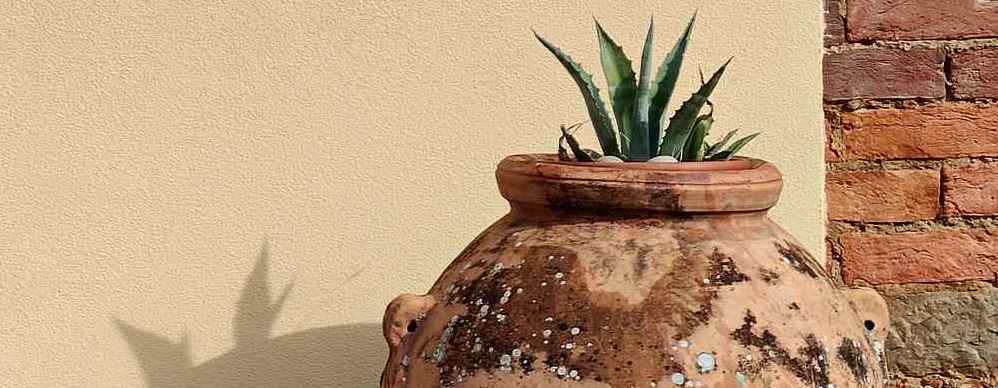
Large urn
April 13, 2026
 På Svenska
This large urn can be found in the courtyard in Moricci, Tuscany. To succeed with this exercise, you will need white paint. I know that this is a color that is not usually included in a watercolorist’s palette, but for this painting it is necessary. If you are going to use white paint to cover previously painted areas, it should be as opaque as possible. For this purpose, I recommend that you skip watercolor whites and instead use gouache, which is an opaque watercolor. The common Chinese white is transparent, and the same goes for zinc white. For maximum covering power, use titanium white, preferably in gouache.
The other colors for this exercise are: French ultramarine, burnt sienna, raw sienna, and a cool red of your choice, as well as the white (preferably titanium white). Depending on how red your burnt sienna is, an additional red may be needed for some of the bricks—many siennas are too orange to produce a good brick red.

Step 1
Draw the subject. Pay attention to the perspective—the paving stones beneath the urn are easy to distort. Study the reference image carefully to get it right. Try to keep a very light touch when drawing the contours of the shadow on the wall.
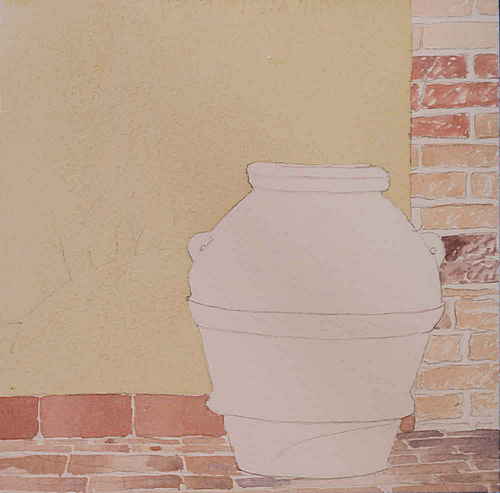
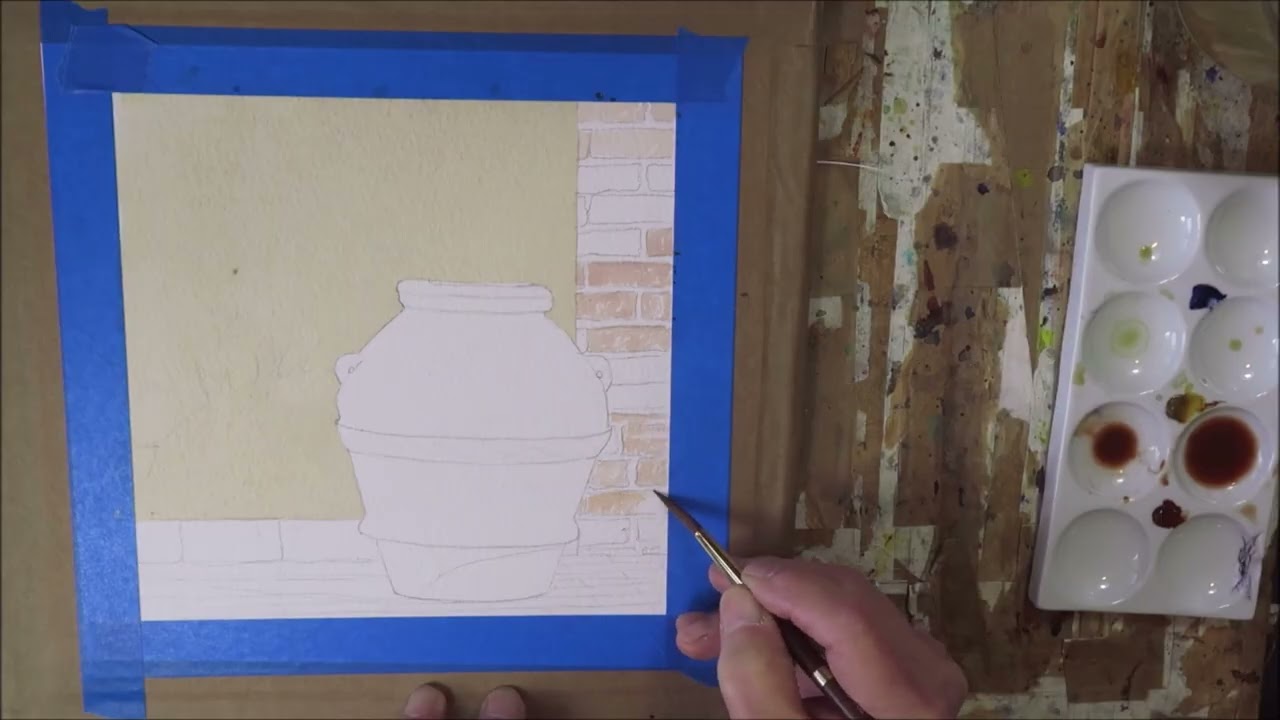
The first thing you paint is the yellow plastered wall. Your raw sienna might be perfect for this muted yellow tone. If not, it is a good idea to mix a more suitable color. The wall should be painted evenly, which requires a fairly fluid wash.
Let the wall dry, then paint all the bricks—some orange-brown, others more reddish, all fairly light to begin with. Feel free to use some drybrush (scumbling) to suggest the rough texture of the stones. Some bricks are redder than others; mix in a bit of red for those. You can also add a little blue to some bricks to make them slightly grayer.
Step 2
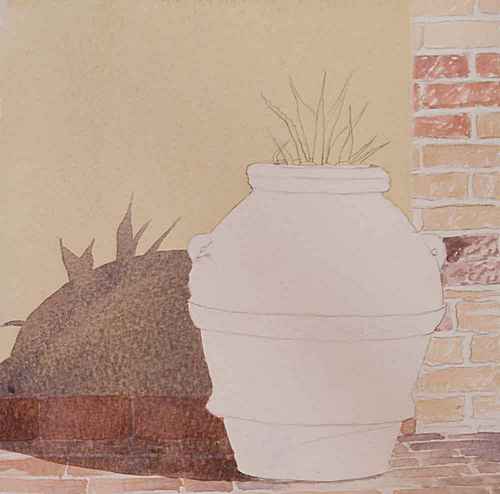
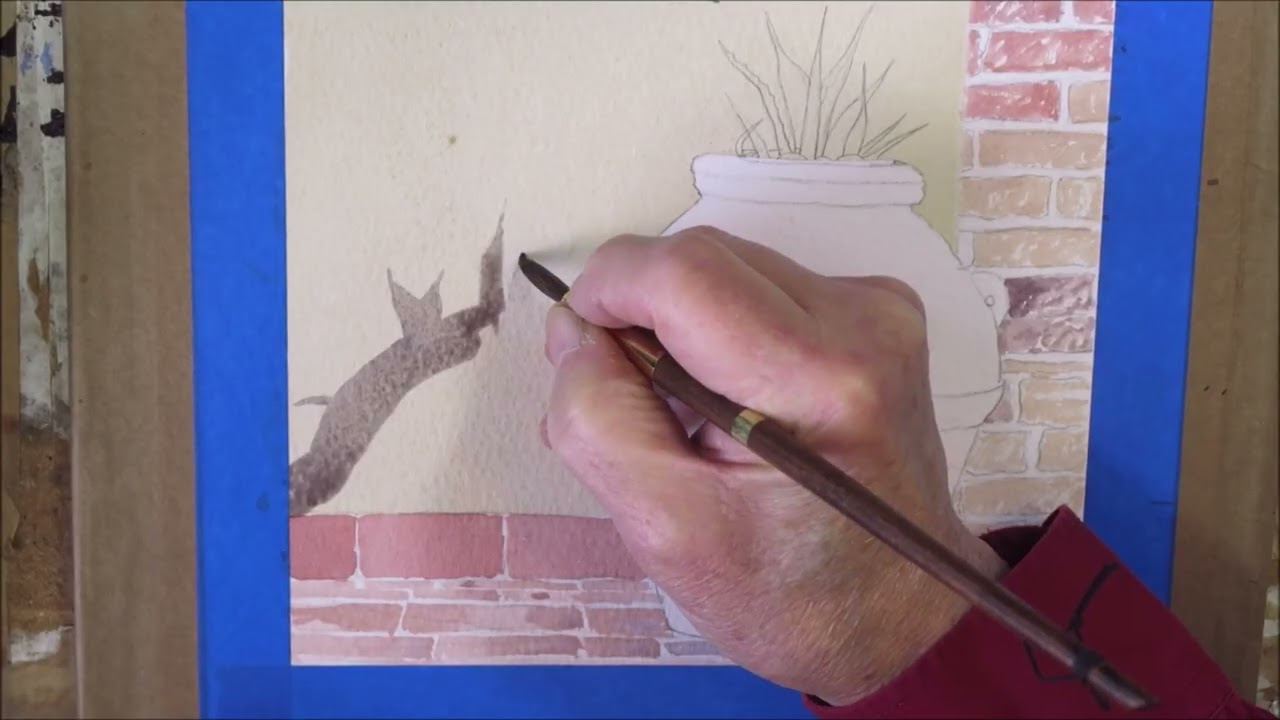
The shadow on the wall should be painted in a grayish tone, mixed from French ultramarine and burnt sienna. Paint it with a fairly fluid wash to avoid blooms or distracting brushstrokes—the surface should be completely even.
Step 3
Now it is time to paint the urn. The main color is burnt sienna, but it can be varied with red and blue. Paint each part of the urn separately, marking out the different sections already at this stage: the rounded upper part, the ornamental band, and the lower section.


The light comes from the right, so the urn should be lightest on that side—this means using more water in the paint there. Once you have established a good form, with a clear shadow on the left and light on the right, you can paint the mottled surface on the upper part. Add small shadows here and there to define the different areas.
Emphasize the shadow on the left side with a fairly dark blue-gray, graded toward the right. You are free to use different techniques for painting the urn: wet-in-wet, layering, and scumbling all work well on its various parts.

Paint the mortar between the bricks with a light gray. Feel free to keep it slightly irregular and leave some small areas unpainted. If needed, you can also refine the bricks.
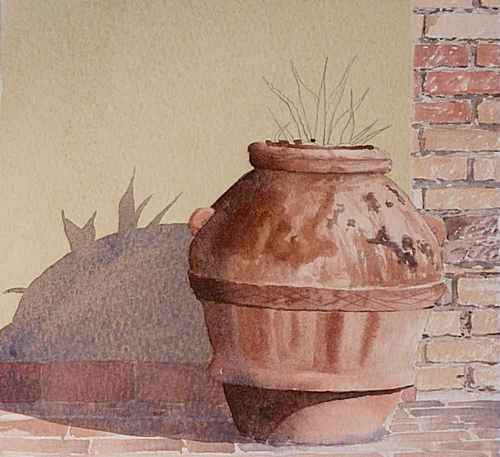
Step 4
When painting a shadow over a previously painted surface, such as the bricks on the wall and ground in this image, some contrast and clarity are lost. For this reason, you can repaint the brick color over the shadowed areas to restore their definition.
Then paint the plant in the urn in two stages: first a green (a mix of raw sienna and French ultramarine will give a fairly muted green), and later the shadows with a very dark green. If necessary, you can clarify the spots on the urn before applying the white paint—once the white is in place, it cannot be corrected.

When you are satisfied with the urn’s shape and mottling, apply the white paint. Keep perspective in mind so that the white lichen appears elongated along the edges and rounder toward the center of the urn. Also paint a few bands of white on the lower part of the urn.
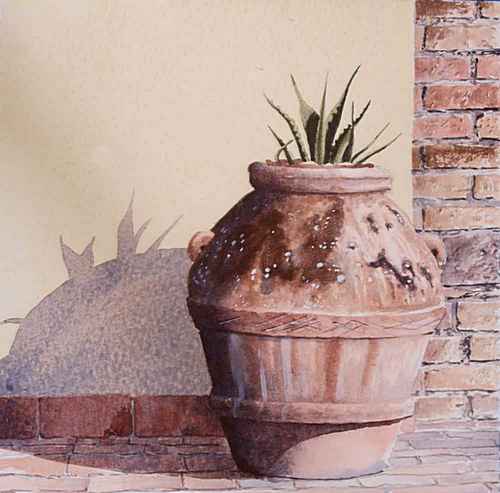
It will look unnatural if the white lichen has no shadow on the shaded side of the urn. Once the white paint has dried, you can glaze over the left side of the urn with a shadow color graded toward the left. If you paint with a fluid wash and avoid scrubbing, the white paint will not lift very much.