
Green Apatite Genuine
March 26, 2026

 På Svenska
Daniel Smith has many colors that use minerals and gemstones as pigments. These colors are placed in a series they call “PrimaTek.” Some of these pigments were commonly used in earlier times, although they are now rare, while others have never been used as pigments and are unique to Daniel Smith.
Apatite is one of these unique colors. It has always been very rare as a pigment. The famous Terracotta Army in China consists of more than 8,000 life-sized soldiers. It has been established that the army was once partly painted with color containing apatite as a pigment. So apatite has been used before, even though the color was—and still is—very uncommon.
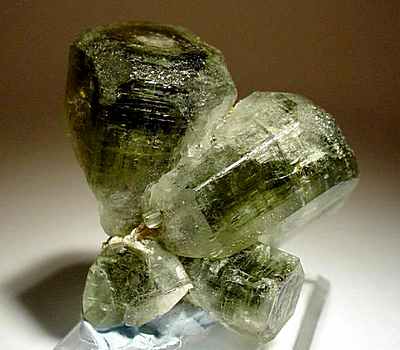

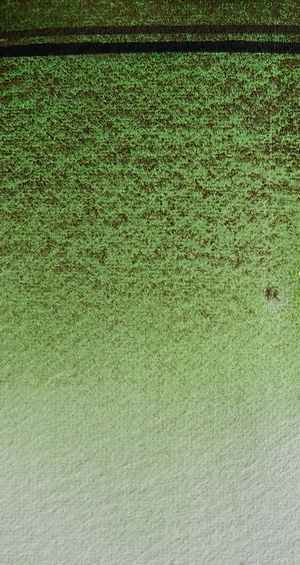
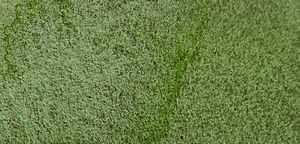
Apatite from Daniel Smith is a yellowish green with dark brown granulation. It is only lightly staining and very lightfast. The color is semi-transparent and lacks the ability to create blooms. On a wet paper surface, it can move surprisingly well for such a heavily granulating color.
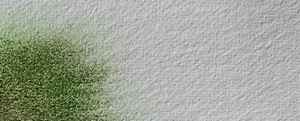
The color has a distinct granulation; the heavier part of the pigment is not green but more brown-black. The green component is in turn divided into a stronger, almost emerald-green part and a lighter, very pale yellow-green. The vignette image above can serve as an illustration: in the lower left, the green areas between the dark brown patches are clearly emerald green, while on the far right there is a band of light, yellow-toned green. The same effect can be seen in the transparency sample below.
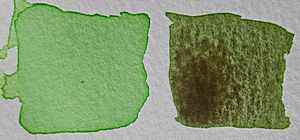
I tried separating the different shades by filling a mixing cup with diluted apatite paint. I then let the cup sit for a while; the heavier part of the pigment settles at the bottom, leaving the yellow-green color on the surface. Carefully, so as not to disturb the sediment, I lifted paint from the surface with a brush and painted the color sample shown here. The result is striking: a beautiful, yellow-green, transparent, and slightly hard-edged color. What remained in the mixing cup I then used for the second color sample.
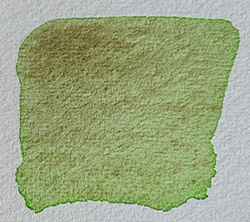
Apatite is a fun color—you could say you get three colors in one tube. I also tried filtering the paint through a regular coffee filter, which worked only moderately well. The largest particles were caught in the filter, but some of the brown pigment grains slipped through. The result was a somewhat yellower color with light brown granulation.
In practice, apatite can be used in all kinds of paintings that include a restrained green. The granulation is what primarily characterizes the color and should be emphasized. It is relatively easy to separate the different hues that the pigment can produce, but perhaps apatite is at its most beautiful when used more “as is,” allowing its fine granulation to shine.
The color is placed in Daniel Smith’s price series no. 3, making it relatively affordable as a mineral paint, but more expensive than “regular” colors.


Pigment: Apatite
Lightfastness: Excellent
Transparency: Semi-transparent
Staining: Yes, but not very much
Granulation: Yes, strong
Hue: Unclear yellow-green