

Celebrate Your Mistakes
June 14, 2026
 På Svenska
Many years ago, I watched a television program featuring an English watercolor artist. I believe it was Alwyn Crawshaw demonstrating how to paint in watercolor. Yes, programs like that were actually shown on television back then!
He was painting a still life with various fruits. In the foreground was a yellow banana, and beside it lay a few plums. He painted the banana first and then moved on to the dark purple plums. While working on the plums, the tip of his brush accidentally touched the freshly painted banana, and the dark violet pigment flowed into the yellow wash.
He could have tried to save the painting. He could have blotted the paint away or removed it with a paper towel, most likely with disastrous results. Instead, he exclaimed: “Look how beautifully the color spreads.”
Then he simply carried on painting as if nothing had happened. The finished painting turned out beautifully.
Most participants in my watercolor classes would immediately try to rescue the banana from being invaded by that almost black color. Most likely, the result would have been a dull and lifeless patch of paint. Attempts at rescue almost always produce something far worse than the mistake they are meant to correct.
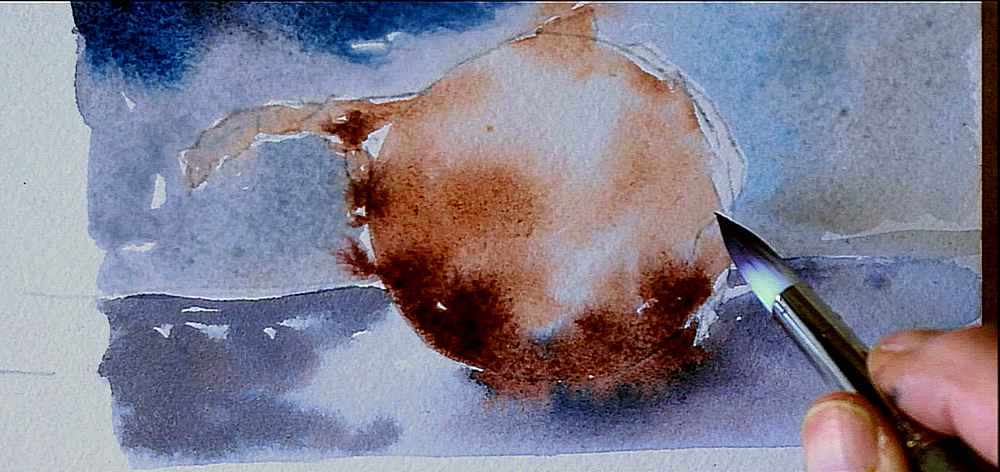
Backruns often provoke the same reaction in my classes. Students immediately try to repair them, especially when they appear in a sky or another smooth, even wash. It almost never works well. If the paint is still wet, a new backrun will form around the repaired area. If the paint has already dried, the color becomes washed out and lifeless. More often than not, it is better to leave the backrun alone—it may actually look quite beautiful.
The same principle applies to crooked lines, unfortunate color choices, and other mistakes. Trying to correct a crooked line by painting a straight one over it rarely works. Let the first brushstroke stand, even if the house ended up leaning or the tree branch became too thick. A spontaneous, slightly crooked line is almost always better than one that has been corrected and painted over.
If you are painting a pear and accidentally make it too red, do not immediately reach for a cloth or a paper towel to remove the paint. Chances are that you will kill the freshness of the color. It becomes even worse if the pear has already started to dry. Blotchy and uninspiring colors are often the result of such repairs. A pear that is too red is still better than a dull pear.
Nor does it usually work well to scrub away the wrong color in order to replace it with another. Granulating colors, in particular, do not respond kindly to such treatment. What remains on the paper is rarely attractive. Colors lose both their brilliance and their transparency when they are removed and painted over.
Watercolor is an unforgiving medium. Attempts to repair mistakes rarely succeed. Yet the mistakes we allow to remain—for everyone makes them—can help make a watercolor painting spontaneous, lively, and beautiful.
Perhaps that is precisely why they sometimes become the strongest parts of the painting.
So the next time you paint a crooked doorframe, give an apple the wrong color, or let a tree bleed into the sky because you were too impatient to wait for the paint to dry, leave the mistake alone. The painting will most likely be better than if you try to fix it.


