
Can You Trust the Name?

 På Svenska
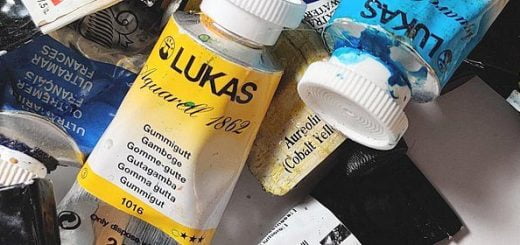
French Ultramarine is always French Ultramarine, isn’t it? And what about Aureolin, Viridian, and Cobalt Blue? Surely these classic colors are always what the label claims they are.
Unfortunately, the name on the tube doesn’t always match what’s inside. Paint manufacturers sometimes take considerable liberties when naming their colors.
If you can’t trust the color name, perhaps you can rely on the Pigment Index instead. For example, PB28—Cobalt Blue—is always the same pigment, right? Well… not entirely.
Color Names
When browsing watercolor color charts, you’ll frequently come across the word Hue. The word simply means a color or shade, but when it appears in a paint name—such as Cadmium Red Hue—it usually means that the paint is an imitation of the original. In other words – a fake.
Naturally, manufacturers want all the famous traditional colors in their range. The problem is that many of those original pigments are no longer available. Some were abandoned because they were toxic, others because they lacked permanence, and some simply fell out of production for other reasons.
That doesn’t stop manufacturers from using names such as Indian Yellow, Vermilion, or Quinacridone Gold. None of these original pigments are still available, yet the names are still widely used.
The replacement is simply whichever pigment comes closest to the original appearance. If no single pigment is a good enough match, several pigments are mixed together to imitate it.
Many manufacturers honestly add the word Hue to indicate that the paint resembles the original without actually being it. Others simply leave that part out and use the original name anyway, even though the pigment inside is something completely different.
Nowadays you’ll also find colors with names such as Cadmium-Free Lemon or Cadmium-Free Red. But here’s the problem: you cannot make a cadmium paint without cadmium. A cadmium-free cadmium color is, no matter how you look at it, not a cadmium color.
Manufacturers want to benefit from cadmium’s excellent reputation while reassuring customers that they’re making a healthier choice. The result is a completely different pigment carrying a name that sounds like a modern version of the original, even though it isn’t.




There are also many paints that imitate expensive pigments even though the genuine pigment is still readily available. This is especially common with costly pigments that are replaced by cheaper alternatives.
Buy an inexpensive Viridian and chances are you’ll get Phthalo Green instead. The same often applies to Aureolin and Cobalt Blue. Expensive pigments are frequently replaced with cheaper ones in student-grade paints.
And no, this isn’t limited to budget paints. The practice can also be found among manufacturers selling professional-quality colors.
The unavoidable conclusion is that the paint’s name tells you surprisingly little about what’s actually inside the paint. Manufacturers choose the name that sells best—not necessarily the one that describes the contents most accurately.
So perhaps the Pigment Index is the reliable part?
Pigment Index Names
A paint carrying the Pigment Index PB29 is Ultramarine. But this is where things become interesting again.
You’ll find paints called French Ultramarine, Ultramarine Green Shade, Green Shade Ultramarine, or simply Ultramarine. All of them may carry the same Pigment Index number: PB29.
The green-shade version of Ultramarine is slightly less reddish than traditional French Ultramarine and often granulates a little less. The Pigment Index is identical, yet the paints are not quite the same.




Four different blue colors, all made from the classic Cobalt Blue – PB28.
Only the first one is called Cobalt Blue. The variants are called something else.
Modern pigment manufacturing allows manufacturers to influence a pigment’s properties through particle size, crystal growth, crystal structure, and subtle variations in the production process. As a result, two paints with the same pigment index name can differ both in color and and handling characteristics.




The Pigment Index tells you only which chemical pigment family the paint belongs to. It says nothing about particle size, crystal structure, granulation, or the exact shade of the color.
Fortunately, manufacturers usually give these variations different names. That’s why a cooler version of Cobalt Blue may be marketed as Cobalt Turquoise, even though both paints are based on the same pigment.
Summary
The conclusion is simple: don’t trust the name on the paint. More often than not, it’s marketing rather than information.
The Pigment Index is far more useful because it tells you which pigment the paint is based on. However, it doesn’t guarantee that two paints with the same index will look or behave exactly alike. Manufacturing methods can give the pigment different characteristics, which is why manufacturers often add terms such as Light, Deep, Green Shade, and similar descriptions.
So ignore what the manufacturer chooses to call the paint—it often says very little about the content. Instead, check the Pigment Index if you want to know what you’re really buying. Just remember that even the Pigment Index doesn’t tell the whole story.
The color name is advertising. The Pigment Index is information. If you want to know what you’re actually buying, read the latter—not the former.