
Raw Sienna
August 12, 2026
 På Svenska
This text and illustrations are updated from a previous version from 2020.
Raw sienna is one of the oldest earth pigments. Soils containing iron oxyhydroxides can produce yellow and yellow-brown pigments, and such earth colours have been used as pigments since prehistoric times. Yellow earth pigments were used, among other things, in ancient Greek and Roman art, including wall paintings and ceramics.
The color we know as Terra di Siena, however, has a more specific origin. During the Renaissance, earth pigments from Tuscany became famous, and the classic sienna came from the ancient lake basins surrounding the Monte Amiata volcano in southern Tuscany. Here, iron-rich sediments formed, consisting mainly of iron oxyhydroxides, especially goethite. The pigment was extracted at several locations around Monte Amiata and became one of the important yellow and yellow-brown earth pigments in European art.
The name Terra di Siena simply means “earth from Siena” and came into use during the Renaissance. The classic sienna from Monte Amiata was essentially a very fine-grained, iron-rich earth with good transparency and a warm yellow colour. It became a well-known artists’ pigment and was used throughout Europe from the Renaissance onwards.
The term raw sienna refers to the distinction between it and burnt sienna. When raw sienna is heated, the chemically bound water is driven out of the iron oxyhydroxides. Iron hydroxide is then converted to iron oxide, and the colour changes from yellow or yellow-brown to a considerably redder and darker tone. The heated pigment is therefore called burnt sienna, while the original pigment is called raw sienna.
Natural sienna from Monte Amiata consists mainly of limonite/goethite and has extremely small pigment particles. It also contains small amounts of manganese compounds, but the manganese content is considerably lower than in many umbers. One modern geological study describes the classic Terra di Siena as consisting of approximately 65–85% limonite/goethite and less than 5% manganese oxide.
It is this very fine particle size and mineral composition that contribute to sienna’s characteristic properties. Natural sienna is often more transparent than many other earth pigments. It can therefore produce warm, transparent washes without becoming as heavy and opaque as many other earth colours.
Today, however, it is by no means certain that a colour called raw sienna contains the classic natural sienna earth from Italy. Synthetic iron oxide pigments are often used to create colours with a similar appearance and properties. Mixtures of several pigments are also common.
What many colours called raw sienna have in common is that they are weakly granulating, non-staining and very lightfast. The colour itself, however, can vary surprisingly much between manufacturers. Most lie somewhere between yellow and yellow-orange, often with a somewhat muted or earthy character. There are also raw siennas that are distinctly yellow, more brownish, or have a slightly pinkish tone.
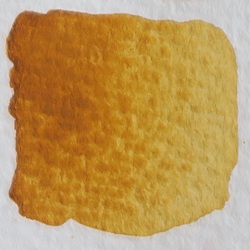
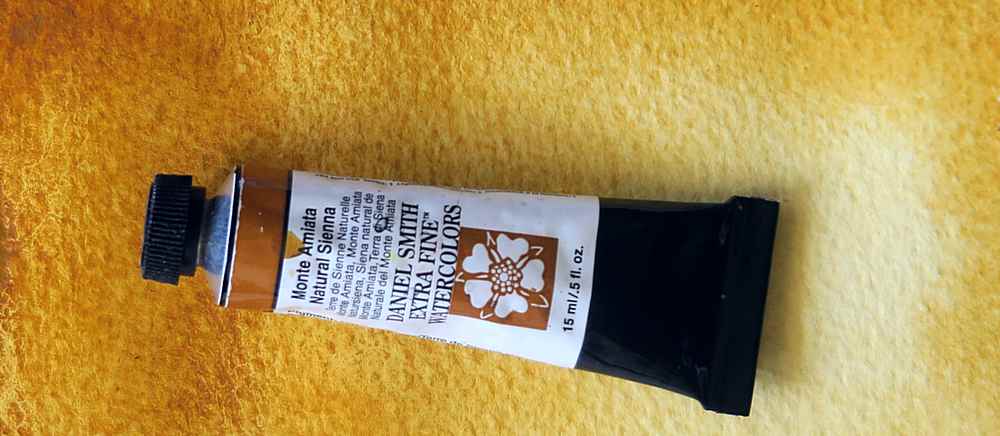
Monte Amiata, natural sienna (PBr7)
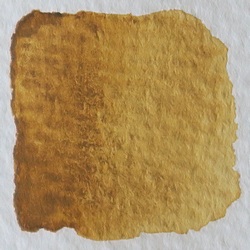
Terra di Siena, obränd (PY43)
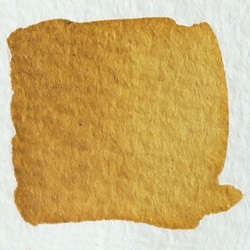
Raw Sienna Naturel (PY43)
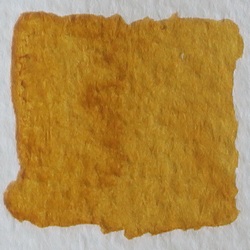
Raw Sienna (PY42+PR101)
It is therefore somewhat misleading to think of raw sienna as a single, precisely defined colour. The name describes more of a group of pigments and colours with a common historical origin and a similar colour range. The differences between manufacturers can be considerable – not only in colour, but also in transparency, granulation and the way the paint behaves on paper.
As with all earth colours, it is therefore a good idea to check what the different manufacturers actually offer before buying a raw sienna. Two colours with exactly the same name can produce very different results in a painting.
The pigment code PBr7 is used for natural iron oxide-based earth pigments, including natural sienna, although PBr7 is sometimes synthetically produced. PY43 is used for natural yellow earth pigments. PY42 is a synthetic yellow iron oxide and PR101 is a synthetic iron oxide. All of these pigments are more or less common for raw sienna. It is also common for manufacturers to mix several pigments to create their own version of raw sienna.
Personally, I prefer colours made from a single pigment. That way I have a better idea of the properties of the paint and can mix the shades I want myself.
Pigment code: PBr7 – PY43 – PY42 – PR101 and more.
Lightfastness: Excellent.
Transparency: Often semi-transparent.
Staining: Not at all.
Granulates: Yes.
Hue: Unclear earthy yellow to orange yellow.




Is Monte Amiata a Primatek color?
They do not call it a Primatek, there are other genuine earth colors from DS that are not Primatek either. Maybe they are just mineral pigments that are allowed to become Primatek?
Monte Amiata is very beautiful indeed.
Hi. Raw Sienna from Daniel Smith is indeed PBr 7, not PY42 as stated in the article.
Thanks for the correction, I have changed the text.