Paint Green Trees
July 16, 2026
 På Svenska
Painting green trees in watercolor can be surprisingly challenging. It is not only difficult to create convincing greens, but also to capture the volume and form of the tree canopy.
In this article I will describe two techniques that I often use when painting green trees. They are very different from one another and suit different painting styles.
Before describing the techniques themselves, I would like to say a few words about color choices. Many artists rely on premixed colors such as Sap Green or Hooker’s Green when painting trees. The result is often rather flat and lacking in contrast, simply because the entire tree ends up being painted with the same shade of green.
Instead, I recommend mixing your own greens. By combining a yellow and blue color, you can create everything from fresh yellow-greens to deep blue-greens. If you want an intense dark green, or simply wish to mute the mixture slightly, add a small amount of red. The red should be a cool red with a slight bias toward violet. Alizarin (PR83) or Quinacridone Rose (PV19) work well, but reddish-brown pigments such as Perylene Maroon (PR179) or Benzimidazolone Red (PR175) are also excellent choices.
Wet into Wet
This is probably the easier of the two techniques. It is fairly quick, but it does require a little experience with the way watercolor spreads across wet paper.
Before you begin, mix at least two different greens. There should be a clear difference between them. One should be a light yellow-green, while the other should be much darker.
The contrast between the two mixtures is important because they will blend together on the paper. If the colors are too similar, the entire tree will end up looking like one uniform green. The paint mixtures should also be fairly concentrated. If a diluted watercolor resembles skimmed milk, these mixtures should have the consistency of heavy cream—or even yogurt.
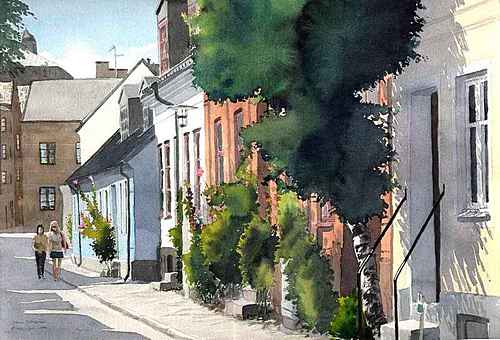
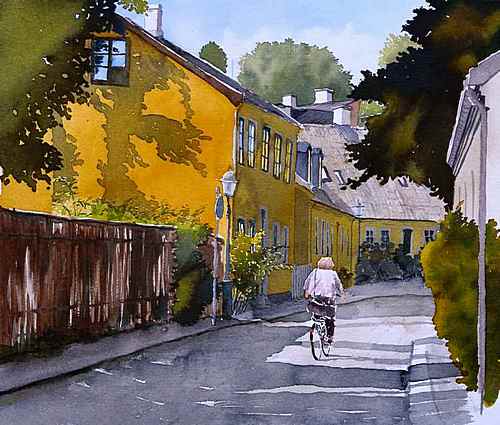
The idea behind this technique is that the spontaneous patterns created by wet-into-wet painting will produce a lively tree canopy with a clear distinction between the sunlit side and the shaded side.
For a small tree, simply paint the entire canopy with the lighter green, then drop the darker green into the shadow side.
For larger trees, that approach usually doesn’t work because the first wash may dry before you have time to add the darker color. Instead, begin on the lightest side of the canopy and gradually work toward the shadows. Pay close attention to the outline of the canopy, allowing the edges to suggest clusters of individual leaves.
As you continue painting, gradually shift to darker green mixtures. It is important to work with a generous amount of paint. The area you are currently painting must remain wet, although the parts you have already finished may begin to dry.

Layer upon Layer
If you choose this method, you will need plenty of patience and time.
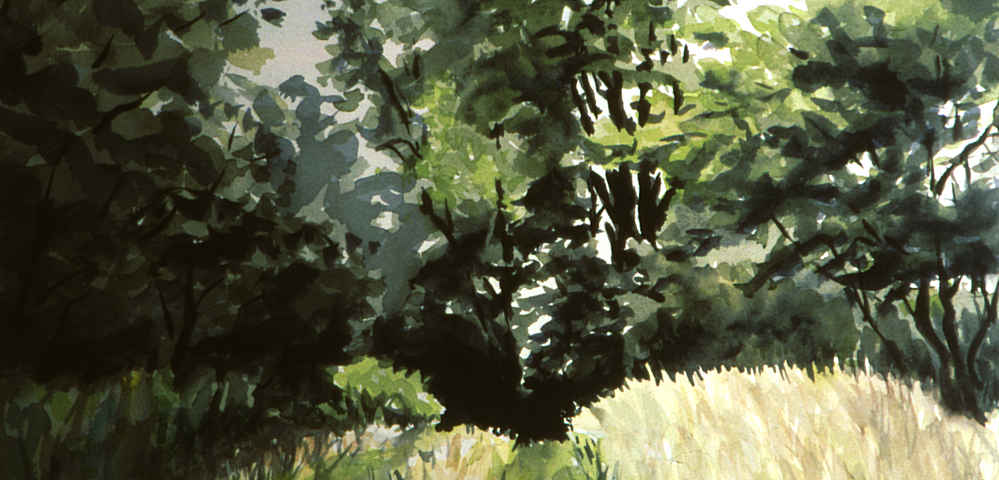
The idea is to build the tree by painting many small brushstrokes on top of one another. Over time they create a pattern of overlapping green shapes that gives the impression of thousands of individual leaves. Because watercolor is transparent, the overlapping layers create depth and a convincing illusion of foliage.
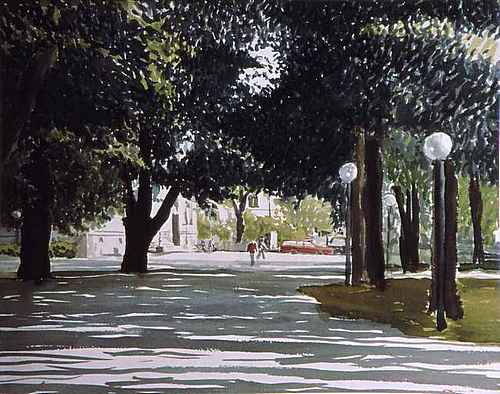
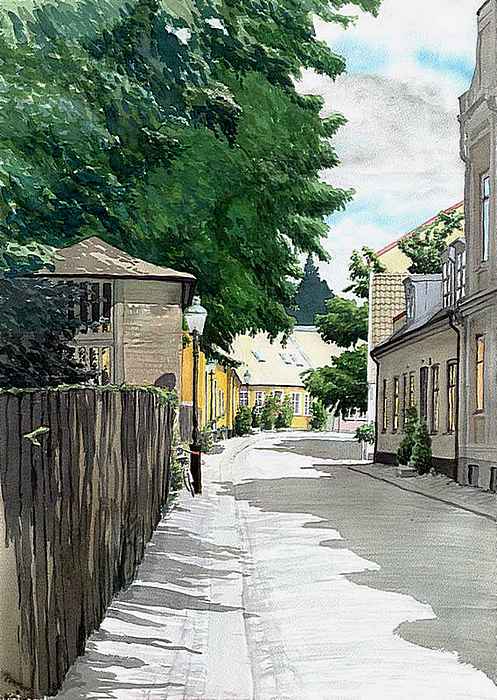
Begin with your lightest green and paint a large number of small brushstrokes. Pay attention to their direction so that the foliage develops a natural structure. Once the first layer has dried completely, apply a second layer using the same green or a slightly darker mixture.
Do not cover exactly the same areas as before. The new brushstrokes should overlap some of the previous ones while leaving others untouched. If you paint quickly and spontaneously, this happens almost automatically.
Avoid painting over the areas that should remain brightest. In those places, a single layer of brushstrokes may be enough. Continue building the foliage in this way until you are satisfied with the result. The final layer should be a deep, dark green.

Summary
There are, of course, many different ways to paint green trees. Here I have described two techniques that I use regularly. They have served me well for many years. In fact, when I look back at photographs of my earliest watercolor paintings, I can see that I was already using these same two methods.
Both techniques rely to some extent on spontaneity. You cannot completely control how watercolor flows across wet paper, nor can you plan the exact placement of every brushstroke in the layered technique. The brushstrokes end up a little scattered, and the paint flows where it wants.
That is part of what makes watercolor such a fascinating medium.